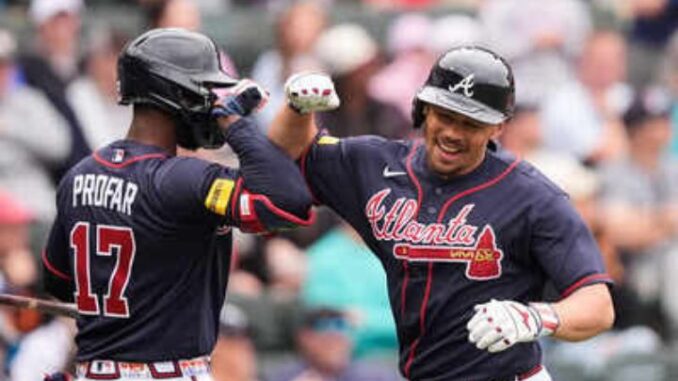
The Atlanta Braves entered the 2026 Major League Baseball season expecting to compete for another postseason run, but an unexpected setback has shaken their early plans. The suspension of outfielder Jurickson Profar for the entire 2026 season has forced the organization to reconsider both its lineup construction and overall roster strategy.
While Profar’s absence primarily affects Atlanta’s offense, the ripple effects of the suspension have opened the door for several potential roster moves. Among the most intriguing developments are trade rumors linking the Braves to Boston Red Sox pitcher Lucas Giolito, a veteran starter who signed a two-year contract worth $38.5 million with Boston.
The speculation has sparked conversations across the baseball world about whether the Braves could once again turn to the Red Sox to strengthen their pitching staff. If the rumors materialize into serious negotiations, it could become one of the most notable moves of the early MLB season.
Jurickson Profar’s suspension changes Atlanta’s plans
The Braves’ offseason plans took a dramatic turn when MLB announced a major suspension for Jurickson Profar. The veteran outfielder tested positive for exogenous testosterone, resulting in a 162-game ban under Major League Baseball’s performance-enhancing drug policy. Because it was his second violation, the suspension covers the entire 2026 season and postseason eligibility.
Profar had signed a three-year contract worth $42 million with Atlanta in 2025 and was expected to be a key contributor near the top of the batting order. His versatility and ability to hit for both average and power made him an important piece of the Braves’ lineup.
Losing a starting-caliber player before the season even begins is a significant blow for any contender. For Atlanta, the suspension not only leaves a hole in the outfield but also disrupts the club’s financial planning and roster balance.
One immediate consequence of the suspension is the financial flexibility it creates. Profar will forfeit his $15 million salary for the 2026 season, giving the Braves additional payroll space that could be redirected toward other needs.
That newfound flexibility is one of the reasons trade speculation has intensified around the Braves.
Why the Braves might pursue pitching help
At first glance, replacing an outfielder might suggest Atlanta would target another bat. However, roster construction in baseball often works in more complex ways. Instead of directly replacing Profar, the Braves could shift their strategy to strengthen other areas of the team.
Pitching depth has always been crucial for a team with championship aspirations. Even teams with strong rotations frequently add another experienced arm to protect against injuries and workload concerns.
Atlanta’s front office, led by general manager Alex Anthopoulos, has a reputation for aggressive and creative roster management. Over the past several years, Anthopoulos has repeatedly made bold trades and free-agent signings designed to keep the Braves among baseball’s elite teams.
That approach has already paid dividends in the past. For example, the Braves once completed a blockbuster deal with the Red Sox to acquire left-handed ace Chris Sale in exchange for infielder Vaughn Grissom.
Given that history, it is not surprising that the Braves have again been linked with Boston in trade discussions.
The potential target: Lucas Giolito
One of the names circulating in trade rumors is Red Sox starter Lucas Giolito. The right-hander signed a two-year contract worth up to $38.5 million with Boston, making him one of the more significant pitching investments in the club’s recent offseason moves.
Giolito has long been regarded as a high-upside pitcher capable of dominating hitters when he is at his best. Earlier in his career, he emerged as a frontline starter and earned an All-Star selection while pitching for the Chicago White Sox.
His pitching style relies heavily on a mix of fastballs and off-speed pitches, particularly a devastating changeup that has helped him generate strikeouts at an elite rate. When he is in rhythm, Giolito can deliver deep outings while limiting hard contact.
For a team like Atlanta, which already boasts a competitive rotation, adding a pitcher with Giolito’s experience could provide both stability and postseason upside.
Why the Red Sox could consider a trade
From Boston’s perspective, trading Giolito is not out of the question. The Red Sox have been reshaping their roster over the past few seasons, making several significant acquisitions and trades in an effort to rebuild their pitching depth and overall competitiveness.
Recent moves have included acquiring veteran starters and signing high-profile pitchers to long-term deals. The team’s rotation has grown increasingly crowded, especially after adding players such as Garrett Crochet, who emerged as one of the league’s most dominant arms in 2025.
When a team has multiple starting options, it can sometimes create an opportunity to move a pitcher for other assets. If Boston decides it needs help in other areas—such as the bullpen or positional depth—a trade involving Giolito could make strategic sense.
Additionally, teams often look to balance long-term payroll commitments. Moving a contract like Giolito’s could give the Red Sox more flexibility for future acquisitions.
How Giolito would fit in Atlanta’s rotation
If the Braves were to acquire Giolito, he would likely slot into the middle of their starting rotation. Atlanta has consistently built its success around strong pitching and reliable starters who can handle heavy workloads.
Adding Giolito could serve multiple purposes:
1. Rotation depth:
Even the best rotations are vulnerable to injuries or fatigue during a long MLB season. Having another proven starter provides insurance.
2. Playoff experience:
Veteran pitchers often become invaluable in postseason scenarios, where every game carries heightened pressure.
3. Strategic matchups:
A pitcher with Giolito’s skill set can give managers more options when planning against tough lineups.
For a team with championship aspirations, these benefits could outweigh the financial cost of taking on the remainder of his contract.
The Braves’ history of bold trades
Atlanta’s willingness to make aggressive roster moves has been a hallmark of the franchise in recent years. The front office has repeatedly demonstrated that it will act quickly when an opportunity arises.
One of the best examples was the acquisition of Chris Sale from the Red Sox. At the time, the move was seen as a calculated risk because of Sale’s injury history. Yet the Braves believed the veteran left-hander still possessed elite talent.
That deal not only strengthened Atlanta’s rotation but also showed the organization’s willingness to trade with familiar partners.
Because Boston and Atlanta have successfully completed major trades before, another deal between the two clubs would not be surprising.
Financial considerations behind the rumor
Money often plays a crucial role in MLB trade decisions. Giolito’s two-year, $38.5 million contract is significant but not overwhelming for a contender like Atlanta.
The Braves’ payroll structure has been carefully managed in recent years, allowing them to maintain flexibility while keeping a core group of star players under long-term contracts.
The absence of Profar’s $15 million salary for 2026 could provide the financial breathing room needed to absorb a portion of Giolito’s contract if a trade were negotiated.
In other words, the suspension that initially appeared to be a purely negative development may indirectly enable the Braves to pursue upgrades elsewhere on the roster.
Challenges and obstacles to a deal
While the trade rumors are intriguing, several factors could complicate any potential agreement between the Braves and Red Sox.
Prospect cost:
Boston would likely demand valuable young talent in return for a pitcher with Giolito’s pedigree.
Health concerns:
Giolito has experienced injury concerns in the past, and teams will carefully evaluate his medical history before committing to a trade.
Market competition:
Other MLB teams may also be interested in acquiring pitching help, which could drive up the price.
Because of these factors, negotiations—if they occur—could be complex and lengthy.
The Braves’ broader strategy for 2026
Beyond this specific rumor, Atlanta’s overall goal remains clear: maintain its status as one of baseball’s top contenders.
The Braves have built a roster featuring a blend of established stars and emerging young talent. Their approach emphasizes both short-term competitiveness and long-term sustainability.
The front office’s challenge will be determining whether acquiring another high-profile pitcher is the best way to address the roster imbalance created by Profar’s suspension.
In some cases, teams prefer internal solutions rather than external trades. Atlanta could decide to rely on its farm system or existing pitching depth instead of pursuing a deal.
What happens next
As the MLB season approaches, speculation surrounding the Braves and Red Sox is likely to intensify.
Trade rumors often gain momentum in the early months of the season as teams evaluate their rosters and identify weaknesses. If Atlanta finds itself needing additional pitching stability—or if Boston decides to reshape its rotation—the possibility of a Giolito trade could become more realistic.
For now, the situation remains a rumor rather than a confirmed negotiation.
Still, the idea of the Braves targeting a $38.5 million Red Sox pitcher highlights how quickly circumstances can change in professional sports. One suspension has already reshaped Atlanta’s outlook for the 2026 season, and it may ultimately lead to one of the most intriguing trades of the year.
Final thoughts
The suspension of Jurickson Profar has created unexpected challenges for the Atlanta Braves, but it has also opened the door for strategic adjustments.
Among the most compelling possibilities is a trade involving Boston Red Sox pitcher Lucas Giolito. With his proven talent, sizable contract, and potential availability, Giolito represents the kind of high-impact player who could strengthen Atlanta’s rotation.
Whether the Braves ultimately pursue this move remains uncertain. However, the speculation underscores the dynamic nature of MLB roster building.
In baseball, adversity often forces teams to think creatively. For the Braves, the fallout from Profar’s suspension may end up reshaping their season—and perhaps even their championship ambitions.
Leave a Reply